
Dr. Andrew Bridges
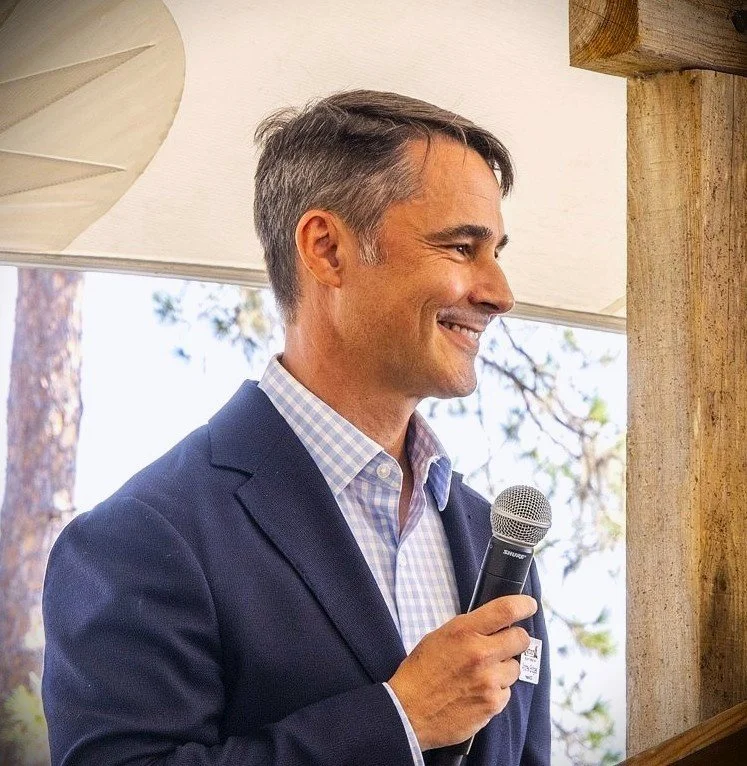
Instructor, Center for Wildlife Studies
Ph.D. Fisheries and Wildlife Sciences, Virginia Tech
M.S. Wildlife and Fisheries Science, Texas A&M
B.S. Environmental Science, University of Florida
Andrew is a wildlife biologist, conservation leader, strategic planner, and educator with more than 25 years of experience in applied wildlife research and conservation. His work spans taxa ranging from large carnivores to anurans, with research addressing wildlife population monitoring, endangered species recovery, invasive species control, and landscape-scale habitat management. Throughout his career, he has focused on weaving together robust scientific evidence with collaborative and inclusive decision-making processes to develop pragmatic and enduring conservation solutions.
In recent years, Andrew has increasingly focused on building the people, partnerships, and organizations that underpin lasting conservation outcomes. He is passionate about developing the next generation of conservationists and helping scientists and practitioners become more effective communicators, leaders, and collaborators. He has led conservation organizations, built multidisciplinary teams, and facilitated collaborative conservation planning across North America and internationally. Andrew especially enjoys drawing on his experiences as a field biologist, researcher, nonprofit leader, and systems thinker to help others develop the skills, confidence, and collaborative capacity needed to tackle today’s complex conservation challenges.
-
Open Standards in the Practice of Conservation
Foundations of Wildlife Conservation and Management - Unit 3
-
Book chapters—
Folk, Travis H. Folk, Ernie Wiggers, Dean Harrigal, Edda Fields-Black, Robert Baldwin, Daniel Hanks, Andrew Bridges, Daniel D. Richter & Andrew Agha. 2026. Historical Landscapes, Conservation and Community: Lowcountry Wetlands and Rice Cultivation in South Carolina. In: Haldon, J.F., Fernandes, R. (eds) Bridging History and Policy. Understanding Complex Systems. Springer, Cham. https://doi.org/10.1007/978-3-032-24379-9_9
Bridges, Andrew S., and Andrew Noss. 2011. Behavior and Activity. Pages 57–69 in Allan F. O’Connell, Jr., James D. Nichols, and Ulas K. Karanth, editors. Camera Traps in Animal Ecology: Methods and Analyses. Springer Press Inc, Tokyo, Japan.
Peer-reviewed—
Green DA, Maestas JM, Sanchez JN, Nieto NC, Bridges AS, Garcelon DK. 2026. Ectoparasite abundance and pathogen prevalence of the San Clemente Island fox (Urocyon littoralis clementae). PLoS One 21(2): e0342760. https://doi.org/10.1371/journal.pone.0342760
Cindy L. Von Haugg, Robert F. Baldwin, Beau A. Bauer, Andrew S. Bridges, Donald L. Hagan, Ernie P. Wiggers, James T. Anderson 2025. Using Camera Traps to Monitor Seasonal and Diel Activity Patterns of Wood Ducks (Aix sponsa) during the Breeding Season. Southeastern Naturalist, 24(3), 368-379.
Von Haugg, Cindy L., Robert F. Baldwin, Beau A. Bauer, Andrew S. Bridges, Ernie P. Wiggers, Donald L. Hagan, and James T. Anderson. 2025. Occurrence of cavities and cavities suitable for nesting wood ducks across South Carolina forest types. Journal of Wildlife Management. https://doi.org/10.1002/jwmg.70059
DeCandia, A.L., Lu, J., Hamblen, E.E., Brenner, L.J., King, J.L., Gagorik, C.N., Schamel, J.T., Baker, S.S., Ferrara, F.J., Booker, M., Bridges, A., Carrasco, C., vonHoldt, B.M., Koepfli, K.-P. and Maldonado, J.E. 2025, Phylosymbiosis and elevated cancer risk in genetically depauperate Channel Island foxes. Molecular Ecology, 34: e17610. https://doi.org/10.1111/mec.17610
Gamblin, Holly, Jesse Maestas, David Green, Andrew Bridges, and David Garcelon. 2024. Patterns of island fox habitat use in sand dune habitat on San Clemente Island. Wildlife Biology e01330. https://doi.org/10.1002/wlb3.01330
Parsons, Mitchell. A., Susan T. Meiman, Steven Munoz, and Andrew S. Bridges. 2022. Nest survival and cause-specific nest mortality in the San Clemente Bell’s Sparrow nests. Journal of Field Ornithology 93:4. https://doi.org/10.5751/JFO-00177-930402
Meiman, Susan T., Emma E. DeLeon, and Andrew S. Bridges. 2020. Reproductive success of the threatened San Clemente Bell’s Sparrow on a recovering landscape: implications for management and monitoring. The Condor 122: 1-11. https://doi.org/10.1093/condor/duz071
Parsons, Mitchell. A., Andrew S. Bridges, Daniel S. Biteman, and David K. Garcelon. 2020. Precipitation and prey abundance influence food habits of an invasive carnivore. Animal Conservation 23(1):60-71. https://doi.org/10.1111/acv.12510.
Bridges, Andrew S., Jessica N. Sanchez, and Daniel S. Biteman. 2015. Spatial ecology of invasive feral cats on San Clemente Island: implications for control and management. Journal of Mammalogy 96(1):81–89. DOI:10.1093/jmammal/gyu005
Bridges, Andrew S., Daniel S. Biteman, Emma E. DeLeon, Brian E. Cross. 2015. Threatened San Clemente Bell’s sparrow nest predated by island night lizard. Western North American Naturalist 75(2):248–249. https://doi.org/10.3398/064.075.0215
Higgins, Taylor W., Andrew S. Bridges, and Jessica N. Sanchez. 2015. Spatial ecology of invasive black rats (Rattus rattus) on San Clemente Island, California. Southwestern Naturalist 60(2):186–192. https://doi.org/10.1894/SWNAT-D-14-00020.1
Bridges, Andrew S., Michael R. Vaughan, and Josephine A. Fox. 2011. Reproductive ecology of American black bears in the Alleghany Mountains of Virginia, USA. Journal of Wildlife Management 75(5): 1137–1144. https://doi.org/10.1002/jwmg.148
Bridges, Andrew S., Michael R. Vaughan, and Josephine A. Fox. 2011. American black bear estrus and parturition in Virginia. Ursus 22(1):1–8. https://doi.org/10.2192/URSUS-D-10-00008.1
Hudgens, Brian R., Naira N. Johnson, James E. Bradley and Andrew S. Bridges. 2009. Benefits of supplemental feeding are climate dependent in the San Clemente Loggerhead Shrike. Proceedings of the California Islands Symposium 7:315–325.
Bridges, Andrew S., Michael R. Vaughan, and Sybille A. Klenzendorf. 2004. Seasonal variation in American black bear activity patterns: quantification via remote photography. Wildlife Biology 10:177–184. https://doi.org/10.2981/wlb.2004.033
Bridges, Andrew S., Josephine A. Fox, Colleen Olfenbuttel, and Michael R. Vaughan. 2004. American black bear denning behavior: observations and applications using remote photography. Wildlife Society Bulletin 32(1):188–193. https://doi.org/10.2193/0091-7648(2004)32[188:ABBDBO]2.0.CO;2
Bridges, Andrew S., Colleen Olfenbuttel, and Michael R. Vaughan. 2002. A mixed regression model to estimate black bear cub age. Wildlife Society Bulletin 30:1253–1258.
Bridges, Andrew S., Markus J. Peterson, Nova J. Silvy, Fred E. Smeins, and X. Ben Wu. 2002. Landscape-scale land-cover change and long-term abundance of scaled quail and northern bobwhite in Texas. Quail V:161–167.
Bridges, Andrew S., Markus J. Peterson, Nova J. Silvy, Fred E. Smeins, and X. Ben Wu. 2001. Differential influence of weather on regional quail abundance in Texas. Journal of Wildlife Management 65:10–18.
Silvy, Nova J., Markus J. Peterson, Jon R. Purvis, and Andrew S. Bridges. 2000. Relationships of fur market conditions to Texas quail populations. Proceedings of the Annual Conference of the Southeastern Association of Fish and Wildlife Agencies 54:266–273.
Bridges, Andrew S., and Michael E. Dorcas. 2000. Temporal variation in anuran calling behavior: implications for surveys and monitoring programs. Copeia 2000(2):587–592. https://doi.org/10.1643/0045-8511(2000)000[0587:TVIACB]2.0.CO;2