

Dr. Hongliang Bu
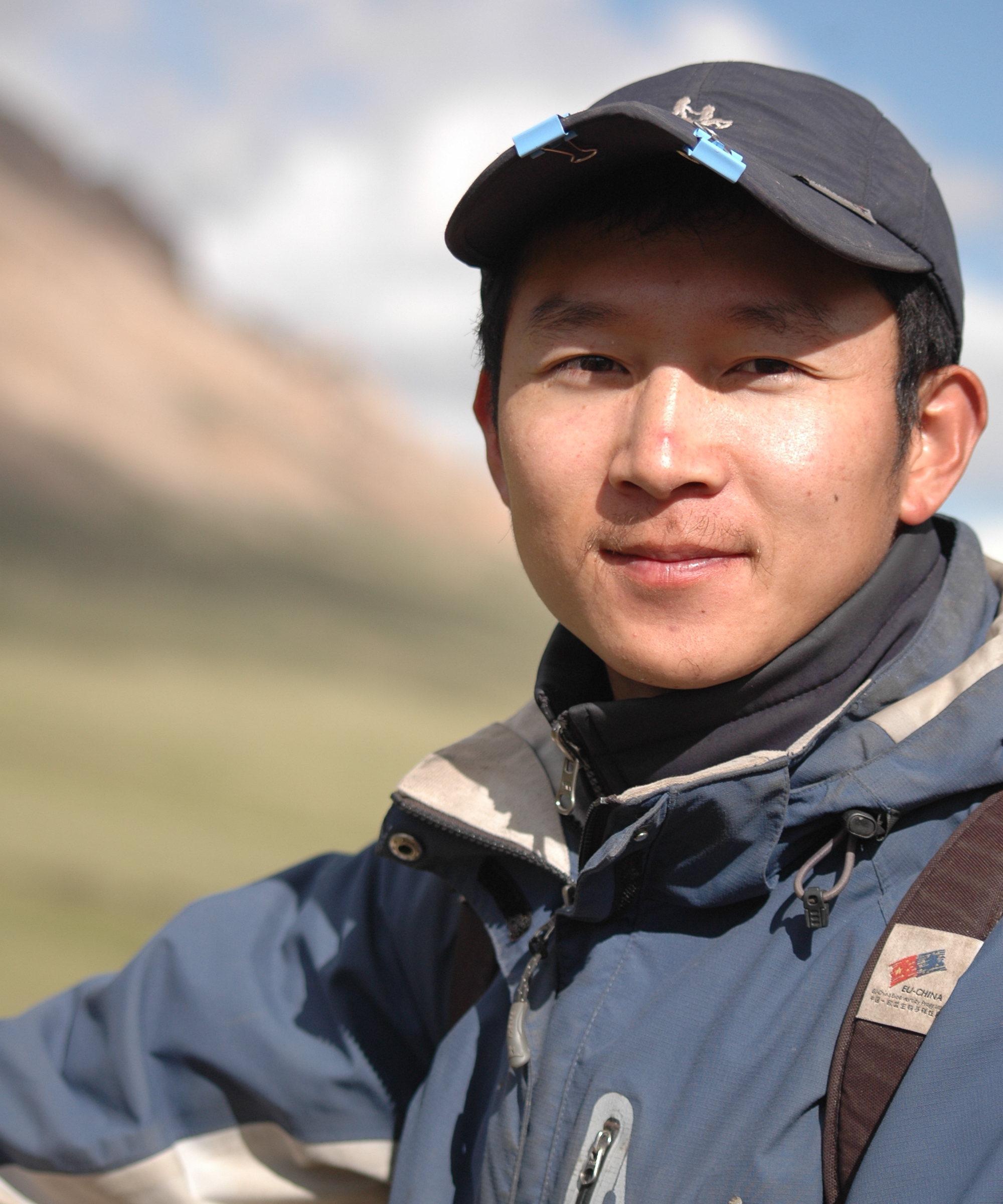
Instructor, Center for Wildlife Studies
Ph.D. Zoology, Peking University
B.S. Thermal Dynamics and Power Engineering, Nanjing University of Science and Technology
Hongliang Bu first trained as an engineer and was attracted to the field of wildlife studies through stories about giant panda research and conservation. Working in the same habitat as the giant panda in the mountains of southwest China, he began his career in wildlife by exploring species interactions among mesocarnivores using camera traps and hair snares. He then earned a Ph.D. in Zoology from Peking University.
Hongliang has worked to model the habitat of the giant panda in the Northern Minshan Mountains, where the largest giant panda population resides. Based on the habitat layer, he delineated the feasible movement corridors for the species and evaluated potential damage to habitat connectivity due to the replacement of native forests by plantations for economic benefits. Hongliang developed strong interests in studying predator-prey interactions, quantifying wildlife responses to anthropogenic influences, trophic cascading effects, and the indirect effects of predation (fear ecology). Recently, he spent a lot of time in the heartland of the Qinghai-Tibetan Plateau to monitor snow leopards and sympatric large carnivores and prey, working to understand dynamic interactions among snow leopards, their competitors, wild prey (mainly blue sheep), and the herding system. He has also worked on a brown bear project involving bear captures and monitoring with collars and camera traps to help mitigate the worsened human-bear conflicts on the Plateau.
-
Wang D., D. Zhang, H. Bu, J.B. Hopkins, M. Xiong, D. Wang, M. Yao, S. Li, & R. Wang. 2024. Estimating the population size of masked palm civets using hair-snaring in Southwest China. Diversity, 16, 421.
https://doi.org/10.3390/d16070421.
Bu H., J. Hopkins, S. Li, & D. 2023. Wang. Seasonal distribution and activity patterns of mesocarnivores and their prey in Southwest China. Journal of Mammalogy.
https://doi.org/10.1093/jmammal/gyad034.
Fan F., H. Bu, W. J. McShea, X. Shen, & S. Li. Free-ranging livestock cause understory degradation of giant panda habitat. Forest Ecology and Management, 538:120990 (IF: 4.384).
https://doi.org/10.1016/j.foreco.2023.120990.
Weng Y., W.J. McShea, Y. Diao, H. Yang, X. Zhang, B. Gu, H. Bu, & F. Wang. 2022. The incursion of free-ranging dogs into protected areas: A spatio-temporal analysis in a network of giant panda reserves. Biological Conservation 265(1):109423.
https://doi.org/10.1016/j.biocon.2021.109423.
Liu M., Y. Wang, F. Xia, H. Bu, Y. Liu, X. Shen, & S. Li. 2022. Free‐ranging livestock altered the spatiotemporal behavior of the endangered North Chinese leopard (Panthera pardus japonensis) and its prey, and intensified human‐leopard conflicts. Integrative Zoology 18(1): 143-156. https://doi.org/10.1111/1749-4877.12635.
Bu H., W.J. McShea, D. Wang, F. Wang, Y. Chen, X. Gu, L. Yu, S. Jiang, F. Zhang, & S. Li. 2021. Not all forests are alike: the role of commercial forest in the conservation of landscape connectivity for the giant panda. Landscape Ecology (IF: 3.848).
https://doi.org/10.1007/s10980-021-01262-2.
Shao X., Q. Lu, M. Liu, M. Xiong, H. Bu, D. Wang, S. Liu, J. Zhao, S. Li, & M. Yao. 2021. Generalist carnivores as effective biodiversity samplers of terrestrial vertebrates. Frontiers in Ecology and the Environment (IF: 11.123) 19(10): 557– 563. https://doi.org/10.1002/fee.2407.
Shao X., Q. Lu, M. Xiong, H. Bu, X. Shi, D. Wang, J. Zhao, S. Li, & M. Yao. 2021. Prey partitioning and livestock consumption in the world’s richest large carnivore assemblage. Current Biology 31(22): 4887-4897. https://doi.org/10.1016/j.cub.2021.08.067.
Fan F., H. Bu, W. J. McShea, X. Shen, B. Li, & S. Li. 2020. Seasonal habitat use and activity patterns of blood pheasant Ithaginis cruentusbe in the presence of free-ranging livestock. Global Ecology and Conservation (IF: 3.380) 23: e01155.
https://doi.org/10.1016/j.gecco.2020.e01155.
Li S., W. J. McShea, D. Wang, X. Shen, H. Bu, T. Guan, F. Wang, X. Gu, X. Zhang, & H. Liao. 2020. Construction progress of the camera-trapping network for the mountains of Southwest China. Biodiversity Science 28 (9): 1049-1058.
Zhao L., M. Liu, C. Luo, H. Bu, D. Ma, X. Shang, & S. Li. 2020. Daily activity rhythm of Ithaginis cruentus in the Wanglang National Nature Reserve, Sichuan. Sichuan Journal of Zoology 39 (2): 121-128.
Bu H., X. Shen, & S. Li. 2019. Predation patterns on artificial nests of ground nesting pheasants in the montane forest, Southwest China. Acta Ornithologica (IF: 1.025) 54(1): 35-43.
https://doi.org/10.3161/00016454AO2019.54.1.003.
Xiong M., D. Wang, H. Bu, X. Shao, D. Zhang, S. Li, R. Wang, & M. Yao. 2017. Molecular dietary analysis of two sympatric felids in the Mountains of Southwest China biodiversity hotspot and conservation implications. Scientific Reports (IF: 4.379) 7: 41909.
http://dx.doi.org/10.1038/srep41909
Bu H., J. B. Hopkins, D. Zhang, S. Li, R. Wang, M. Yao, & D. Wang. 2016. An evaluation of hair-snaring devices for small-bodied carnivores in Southwest China. Journal of Mammalogy (IF: 2.416) 97(2): 589-598.
https://doi.org/10.1093/jmammal/gyv205.
Bu H., F. Wang, W. J. McShea, Z. Lu, D. Wang, & S. Li. 2016. Spatial co-occurrence and activity patterns of mesocarnivores in the temperate forests of Southwest China. PLoS ONE (IF: 3.240) 11: e0164271.
https://doi.org/10.1371/journal.pone.0164271.
Xiong M., X. Shao, Y. Long, H. Bu, D. Zhang, D. Wang, S. Li, R. Wang, & M. Yao. 2016. Molecular analysis of vertebrates and plants in leopard cat (Prionailurus bengalensis) scat in southwest China. Journal of Mammalogy (IF: 2.416) 97: 1054-1064.
https://doi.org/10.1093/jmammal/gyw061.
Zhang D., M. Xiong, H. Bu, D. Wang, S. Li, M. Yao, & R. Wang. 2016. Sex identification of the masked palm civet (Paguma larvata) using noninvasive hair samples. Conservation Genetics Resources (IF: 0.973):1-3.
Li S., D. Wang, H. Bu, X. Liu, & T. Jin. 2016. Camera-trapping survey on the mammal diversity of the Laohegou Nature Reserve, Sichuan Province. Acta Theriologica Sinica 36 (3): 282-291.
Zhang D., L. Xu, H. Bu, D. Wang, C. Xu, & R. Wang. 2015. The complete mitochondrial genome of the masked palm civet (Paguma larvata, Mammalia, Carnivora). Mitochondrial DNA (IF: 0.922):1-2.