
 Image 1 of 1
-
Documenting how ecological communities change across space and time can provide insight into important ecological processes. This course will explore the conceptual development of the field of community ecology and how it informs contemporary approaches to conservation and land management. We will also focus on methods used to analyze communities, including field survey methods and study design principles. We will briefly discuss statistical approaches to community analysis, with the goal of providing a synthetic overview of analytic approaches; learners should plan to take additional courses to reach proficiency in statistics used for community ecology. Examples given in this course will primarily focus on plant communities and vegetation, since these were the original focus of community ecology techniques, but the concepts we explore are applicable to communities of any taxonomic group. Learners will be invited to practice collecting field data wherever they live.
-
Spring: April 6 – June 28, 2026 (Early bird ends March 8th)
*Early bird saves $75
-
None, but basic experience in R is useful (e.g., R Boot Camp).
-
How to do Ecology by Richard Karban et al. (third edition)
Analysis of Ecological Communities by McCune and Grace (optional)
Additional readings provided by instructor
-
By the end of this course, learners will be able to:
Interpret and discuss the history of community ecology and the frontiers of the field today
Design robust studies of ecological communities with high capacity for inference
Apply best practices for managing ecological community data
Choose among analytic approaches for community data
Module 1: Foundations of Community Ecology
Module 2: Sampling Methods and Study Design
Module 3: Community Data Management and Inference
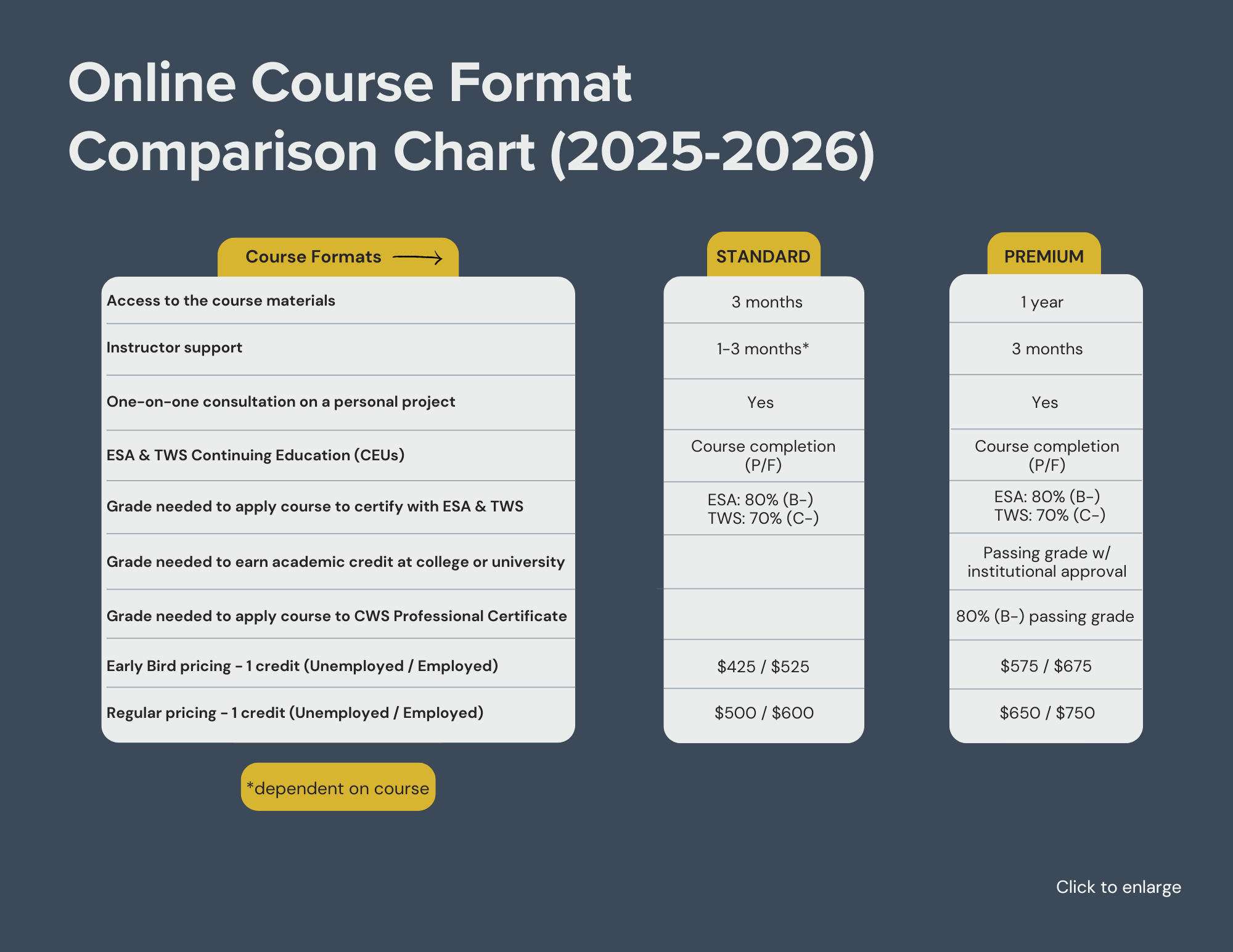
COURSE OPTIONS & INFORMATION (Review chart above, then click below)
-
FORMAT:
3 months of access to course materials as you work at your own pace
Get instructor support for the 3-month term via email, discussion threads, group meetings, and one-on-one appointments
After working through the course materials, set up an optional meeting with the instructor to discuss your own personal project from work or school
CONTINUING EDUCATION:
16 CEUs with The Wildlife Society
CERTIFICATIONS:
Earn 1 credit toward certification as an Associate/Certified Wildlife Biologist® (at any level) with The Wildlife Society
-
FORMAT:
12 months of access to course materials as you work at your own pace
Get instructor support for the 3-month term via email, discussion threads, group meetings, and one-on-one appointments
After working through the course materials, set up an optional meeting with the instructor to discuss your own personal project from work or school
CONTINUING EDUCATION:
16 CEUs with The Wildlife Society
Go to our Continuing Education Page for more details
CERTIFICATIONS:
Earn 1 credit towards a professional certificate in Applied Quantitative Ecology with CWS
Earn 1 credit toward certification as an Associate/Certified Wildlife Biologist® (at any level) with The Wildlife Society
ACADEMIC CREDIT:
Earn 1 academic credit (go to our Academic Credit Page for details)
Earn an additional 1-2 academic credits with an Applied Project

INSTRUCTOR
SCHOLARSHIPS
Full scholarships are available to participants from countries designated as “lower income” and “lower middle income” in the World Bank List of Economies. Please see our CWS World Scholars Program page for details.
CANCELLATION POLICY
Cancellations 30 days or more before the start date are not subject to cancellation fees. Cancellations <30 days before the start date are subject to a 50% cancellation fee. No refunds once the course begins.