

 Image 1 of 1
-
This course provides a thorough introduction to integrated population models, i.e. population dynamics models in which the parameters are estimated using two or more datasets. We show how to use Bayesian methods to fit a wide variety of models, via the package jagsUI within R, which provides an interface to the JAGS software. We show how to construct both the population model and the observation model needed for each dataset. Participants will learn how to fit population models to real-world data, via case studies that include data on counts, productivity, mark-recapture, dead-recoveries, and radio-tracking. There is also an emphasis on both model-checking and model comparison to aid model development and refinement.
-
Fall: Sept 8 – Dec 20, 2026 (Early bird* ends Aug 9)
Spring: Jan 19 – May 2, 2027 (Early bird* ends Dec 20)
*Early bird saves $75 Standard, $85 for Premium
-
Experience in fitting Bayesian models in R, as provided by the CWS courses Introduction to Bayesian Modeling and Bayesian Hierarchical Modeling. A basic understanding of population ecology will be assumed.
-
We will make extensive use of the following book, which is highly recommended as background reading:
Schaub M & Kéry M (2021) Integrated Population Models: Theory and Ecological Applications with R and JAGS. Academic Press.
-
By the end of this course, learners will be able to:
Explain and apply concepts and techniques used to fit an integrated population model (IPM) in the Bayesian framework
Evaluate assumptions and model fit for Bayesian IPMs
Compare the fit of two or more Bayesian IPMs using WAIC weights
Assess the key components to fitting a Bayesian IPM in R using JAGS
Fit a Bayesian IPM to different types of data, including counts, productivity, and mark-recapture data
Fit a Bayesian IPM to estimate different types of demographic parameter, including survival, productivity, immigration, and dispersal
Fit a Bayesian IPM in which one of more of demographic parameter is specified as a random effect
Fit a Bayesian state-space model to mark-recapture data
Module 1: Introduction to Integrated Population Models
Module 2: Woodchat Shrike Case Study
Module 3: Black Grouse Case Study
Module 4: Peregrine Falcon Case Study
Module 5: Elk Case Study
Module 6: Cormorant Case Study
Module 7: State-Space Models
Module 8: Overview and Review of the Course
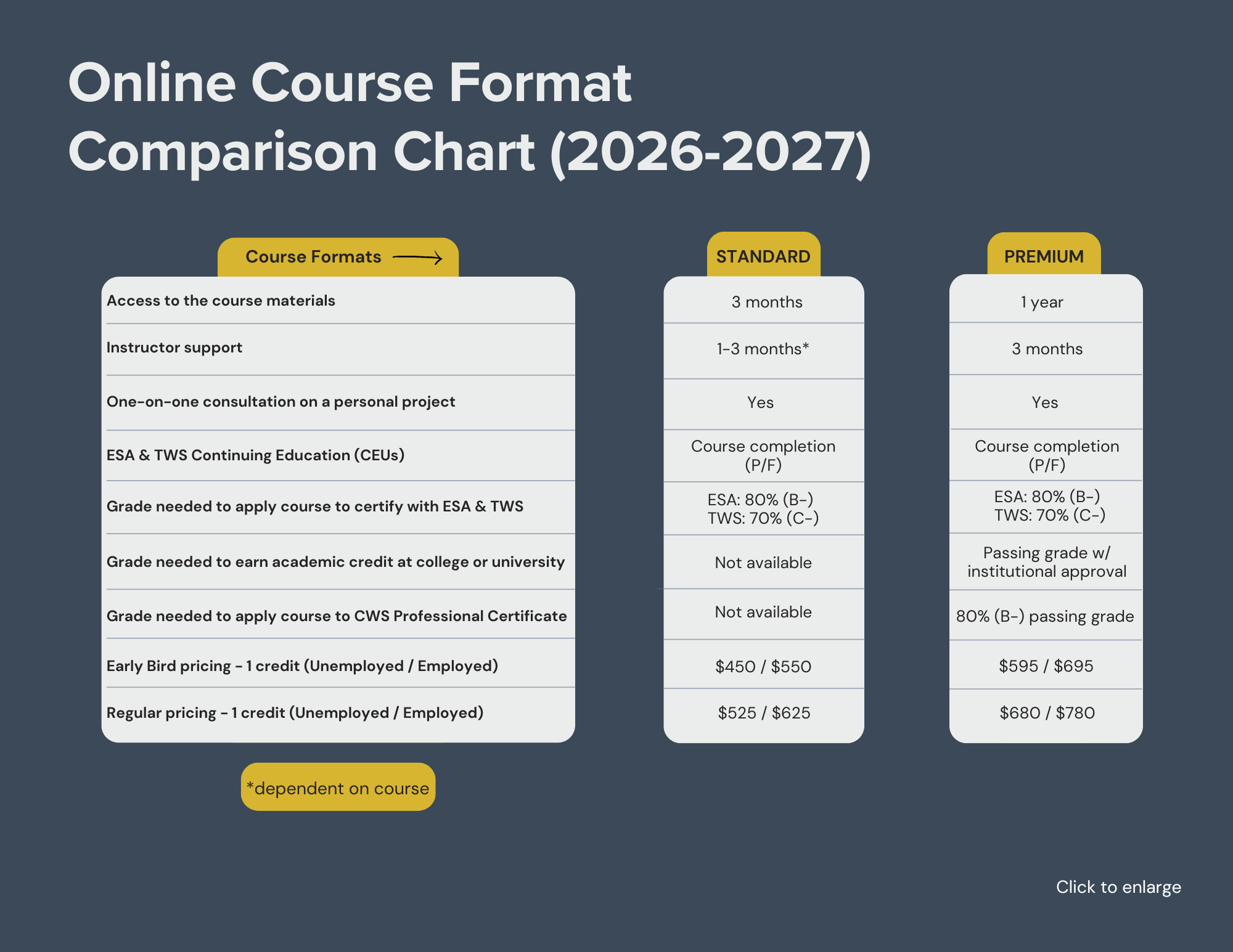
COURSE OPTIONS & INFORMATION (Review chart above, then click below)
-
FORMAT:
3 months of access to course materials as you work at your own pace
Get instructor support for the 3-month term via email, discussion threads, group meetings, and one-on-one appointments
After working through the course materials, set up an optional meeting with the instructor to discuss your own personal project from work or school
CONTINUING EDUCATION:
16 CEUs with The Wildlife Society
CERTIFICATIONS:
Earn 1 credit toward certification as an Associate/Certified Wildlife Biologist® (at any level) with The Wildlife Society
-
FORMAT:
12 months of access to course materials as you work at your own pace
Get instructor support for the 3-month term via email, discussion threads, group meetings, and one-on-one appointments
After working through the course materials, set up an optional meeting with the instructor to discuss your own personal project from work or school
CONTINUING EDUCATION:
16 CEUs with The Wildlife Society
Go to our Continuing Education Page for more details
CERTIFICATIONS:
Earn 1 credit towards a professional certificate in Applied Quantitative Ecology with CWS
Earn 1 credit toward certification as an Associate/Certified Wildlife Biologist® (at any level) with The Wildlife Society
ACADEMIC CREDIT:
Earn 1 academic credit (go to our Academic Credit Page for details)
Earn an additional 1-2 academic credits with an Applied Project

INSTRUCTOR
SCHOLARSHIPS
Full scholarships are available to participants from countries designated as “lower income” and “lower middle income” in the World Bank List of Economies. Please see our CWS World Scholars Program page for details.
CANCELLATION POLICY
Cancellations 30 days or more before the start date are not subject to cancellation fees. Cancellations <30 days before the start date are subject to a 50% cancellation fee. No refunds once the course begins.