
 Image 1 of 1

-
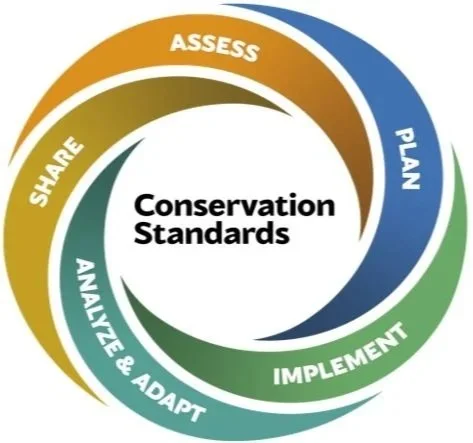
Faced with limited resources and increasingly complex environmental challenges, conservation organizations and professionals must ensure their efforts are strategic, systematic, collaborative, and results-oriented. This course introduces participants to the Conservation Standards (CS), an internationally recognized planning framework for designing, implementing, monitoring, evaluating, and adapting conservation projects to achieve measurable conservation and sustainability impact.
Through a combination of theoretical foundations, applied exercises, and group project development participants gain practical skills in conservation planning and adaptive management. These include assessing conservation contexts, identifying conservation targets and threats, analyzing complex social-ecological systems, developing goals and objectives, designing strategies and theories of change, and establishing approaches to monitor and evaluate progress, analyze results, and adapt management actions.
The course emphasizes the application of the Conservation Standards through assessment and planning, integrating scientific evidence, systems thinking, stakeholder engagement, and collaborative decision-making. By applying these concepts and tools to a conservation project, participants gain experience in developing strategic, evidence-based approaches to address conservation challenges and the skills needed to evaluate, communicate, and improve conservation outcomes.
-
Learn at your own pace with instructor support (see Online Course Format Chart below for details).
Spring: January 19 - May 2, 2027 (Early bird* ends December 20th)
See TOPICS & LEARNING OUTCOMES below for the details.
*Early bird saves $75 off Standard, $85 off Premium
-
This course involves working collaboratively in groups. Participants should be prepared to coordinate with their group members, including arranging meetings as needed, to complete assignments.
Participants first learn and apply the Conservation Standards through a shared case study (weeks 2-7), then repeat the planning process with a second conservation project (weeks 8-13). This iterative approach strengthens their ability to apply the framework independently, work collaboratively, and develop practical conservation plans. The course emphasizes Steps 1 (Assess) and 2 (Plan) of the Conservation Standards project cycle.
Schedule
Week 1
Module 1: Foundations of Conservation Planning and the Conservation Standards; course orientation and introduction to planning tools
Weeks 2–7
Modules 2–6: Apply Steps 1 and 2 to a shared conservation case study; develop and present the first draft conservation plan
Weeks 8–13
Modules 2–6: Repeat the planning process with a second conservation project selected by participants and/or instructors
Week 14
Final conservation plans, presentations, peer review, and synthesis of lessons learned
-
Basic understanding of ecological and conservation practices is helpful, but no prior experience with adaptive management or the Conservation Standards is necessary.
-
Module 1: Foundations of Conservation Planning and the Conservation Standards
Upon completion of this module, participants will be able to:
Explain the purpose, principles, and structure of the Conservation Standards and their application to strategic conservation planning and adaptive management.
Describe the evolution of the Conservation Standards and their role in improving conservation practice.
Analyze the ecological, social, and institutional context of the course's shared conservation case study.
Demonstrate familiarity with the course's collaborative learning environment and conservation planning tools, including Canvas, Miradi, and/or Mural.
Identify the roles and responsibilities of project team members and establish collaborative working arrangements.
Module 2: Project Team, Scope, and Vision
Upon completion of this module, participants will be able to:
Define the purpose, composition, and roles of a conservation project team.
Analyze available ecological, social, and geographic information to establish an appropriate project scope.
Develop a clear and compelling project vision that describes the desired future condition of the conservation area or issue.
Document the project team, scope, and vision using conservation planning tools and established Conservation Standards criteria.
Module 3: Conservation Targets and Viability Assessment
Upon completion of this module, participants will be able to:
Distinguish between biodiversity conservation targets and human well-being targets and explain their relevance to conservation planning.
Identify and select representative conservation targets based on the project's scope and available information.
Assess the viability of selected biodiversity targets by identifying key ecological attributes, indicators, and current and desired future conditions.
Document and justify target selection and viability assessment results using conservation planning tools.
Module 4: Direct Threats, Threat Rating, and Situation Analysis
Upon completion of this module, participants will be able to:
Identify and classify direct threats affecting selected biodiversity conservation targets.
Evaluate and prioritize direct threats using established threat-rating criteria.
Analyze the indirect threats, contributing factors, stakeholders, and opportunities influencing priority direct threats.
Construct a situation model illustrating the causal relationships among conservation targets, direct threats, contributing factors, and opportunities.
Module 5: Conservation Goals, Strategies, and Refining Situation Models
Upon completion of this module, participants will be able to:
Develop measurable, time-bound conservation goals for selected biodiversity and human well-being targets.
Critically evaluate and refine situation models to clarify causal relationships and identify key intervention points.
Identify potential conservation strategies that address priority threats and their underlying contributing factors.
Evaluate and prioritize strategies based on their anticipated effectiveness, feasibility, and contribution to conservation goals.
Module 6: Theory of Change, Results Chains, Objectives, and Monitoring
Upon completion of this module, participants will be able to:
Explain the role of theories of change and underlying assumptions in linking conservation strategies to desired results.
Construct a results chain for a selected conservation strategy that illustrates the anticipated sequence of changes leading to conservation outcomes.
Develop measurable, time-bound objectives for key intermediate results within a results chain.
Identify activities and monitoring indicators needed to implement strategies, assess progress, and test assumptions.
Integrate project planning outputs into a draft conservation action plan and evaluate how monitoring results can inform adaptive management.
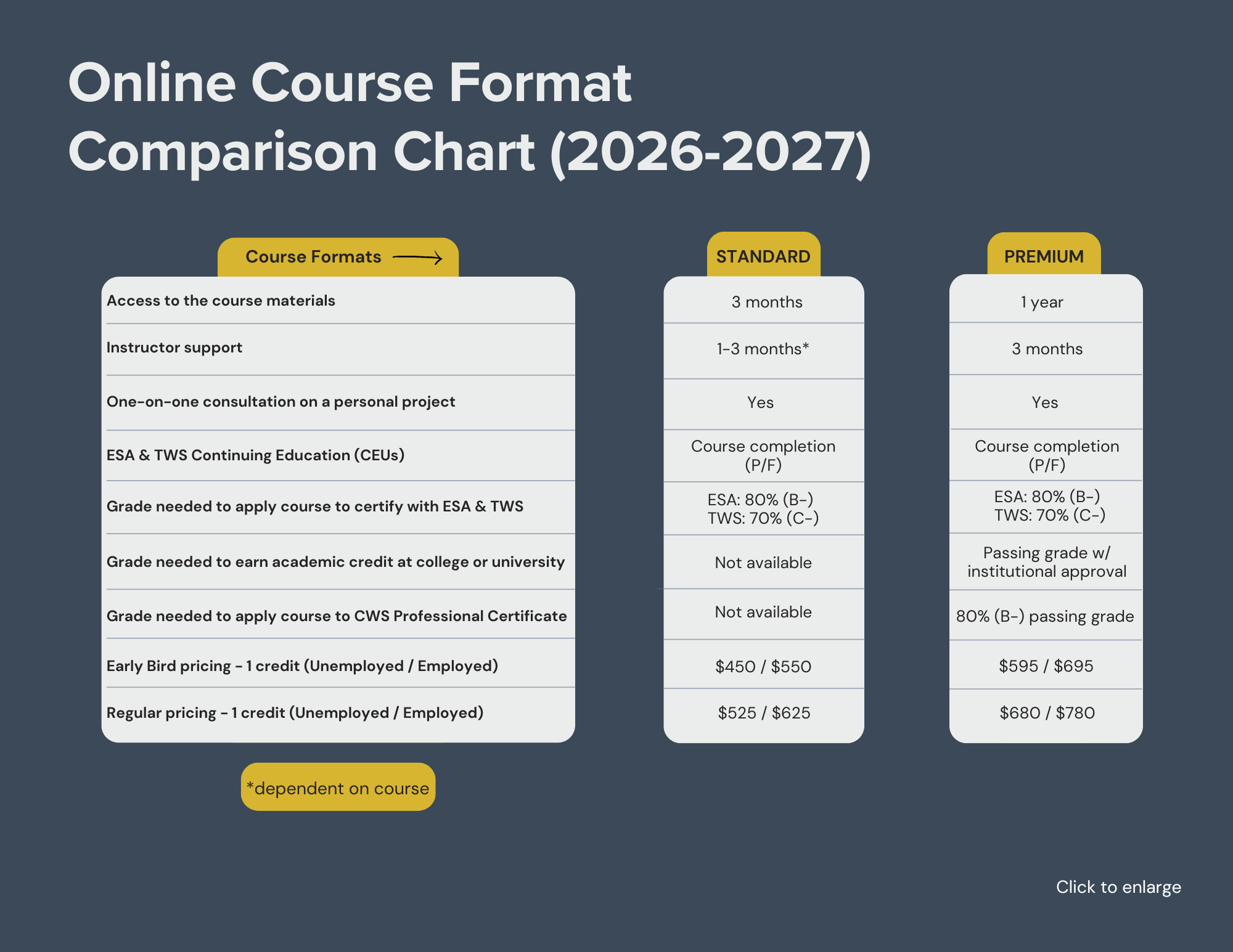
COURSE OPTIONS & INFORMATION (Review chart above, then click below)
-
FORMAT:
15 weeks of access to course materials as you work at your own pace
Get instructor support for the 15-week term via email, discussion threads, group meetings, and one-on-one appointments
After working through the course materials, set up an optional meeting with the instructor to discuss your own personal project from work or school
CONTINUING EDUCATION:
16 CEUs with The Wildlife Society
CERTIFICATIONS:
Earn 1 credit toward certification as an Associate/Certified Wildlife Biologist® (at any level) with The Wildlife Society
-
FORMAT:
12 months of access to course materials as you work at your own pace
Get instructor support for the 15-week term via email, discussion threads, group meetings, and one-on-one appointments
After working through the course materials, set up an optional meeting with the instructor to discuss your own personal project from work or school
CONTINUING EDUCATION:
16 CEUs with The Wildlife Society
Go to our Continuing Education Page for more details
CERTIFICATIONS:
Earn 1 credit toward a professional certificate in Conservation Planning with CWS
Earn 1 credit toward certification as an Associate/Certified Wildlife Biologist® (at any level) with The Wildlife Society
ACADEMIC CREDIT:
Earn 3 academic credits (go to our Academic Credit Page for details)
-
This course may be taken for 3 academic credits when registering for the PREMIUM format. Credit is not available for STANDARD.
Credits may be obtained via CWS’s partnership with Colby-Sawyer College or directly through your home institution. For details about academic credit options, please visit https://www.centerforwildlifestudies.org/ac-option
For credit through Colby-Sawyer College, a $75 per credit transcript fee applies.
INSTRUCTOR
SCHOLARSHIPS
Full scholarships are available to participants from countries designated as “lower income” and “lower middle income” in the World Bank List of Economies. Please see our CWS World Scholars Program page for details.
CANCELLATION POLICY
Cancellations 30 days or more before the start date are not subject to cancellation fees. Cancellations <30 days before the start date are subject to a 50% cancellation fee. No refunds once the course begins.