
 Image 1 of 1
-
Insects are fundamental to the world as we know it. They are pollinators, decomposers, predators, food, and essential in scientific fields, like genetics.
This 3-unit entomology course series will teach you some of the fundamentals of entomology. Each unit builds from the last, though stands independently. Units may be taken together or individually.
Unit 1, Introduction to Insects, focuses on getting to know insects. We will cover a brief evolutionary understanding of where insects come from. Recognizing the basic features of insect anatomy is essential to being able to discuss the importance of these animals to the ecosystem. This unit provides the foundation for exploring insects at a deeper level.
Unit 2, Insects & Their Environments, begins by exploring how insects perceive their world through different types of sensory biology, including vision, hearing, smell, and more. By understanding their physiology, we can begin to recognize what is important in their environments. We then examine how insects interact with their environment in particular habitats, focusing on their ecological benefits and their roles as pests. Finally, we think about insects in society. This includes their own societies and our society—in particular how we view them as food.
Unit 3, Insect Taxonomy & ID, explores the different groups of insects. Insect taxonomy is a basic step to wildlife conservation, genetics, physiology, and more. If you cannot name and categorize insects, you cannot differentiate them and explain a need to conserve one population over another. The unit covers how to identify specific insect groups, including larger groupings, orders, and some families. Learners will be given the tools to be able to identify insects, use a dichotomous key, and participate in valuable citizen science.
By the end of the three units, learners will be able to take an unknown insect and deduce information about its role in nature.
-
Learn at your own pace (see Online Course Format Chart below for details).
Spring 2027: The first 5 weeks of each unit include instructor support.
Unit 1: January 19 - May 2, 2027
Unit 2: Feb 22 - June 6, 2027.
Unit 3: March 29 - July 11, 2027.
Early bird discount of $75 on Standard, $85 on Premium ends December 20, 2026.
-
This is a 3-credit course, consisting of three 1-credit units that may be taken together or individually. You may register for 1, 2, or all 3 units. Select the units during registration.
Each unit has 5 weeks of self-paced instruction with instructor support. After the 5-week period ends, learners have access to material on Canvas for an additional 10 weeks.
-
Introductory biology is recommended. While learners are encouraged to take the three units in sequence, this is not required.
-
Unit 1: Introduction to Insects
Recognize key shared attributes of insects
Identify key external anatomy features
Explain insect’s internal anatomy and physiology
Describe the basics of insect development and reproduction
Unit 2: Insects & Their Environments
Describe the ways insects perceive their environments through their sensory mechanisms
Connect environmental niches to insects and their beneficial roles within each space
Summarize how insects are pests to crops and people as vectors
Unit 3: Insect Taxonomy & ID
Identify broad groups of insects
Use a dichotomous key
Participate in citizen science with iNaturalist
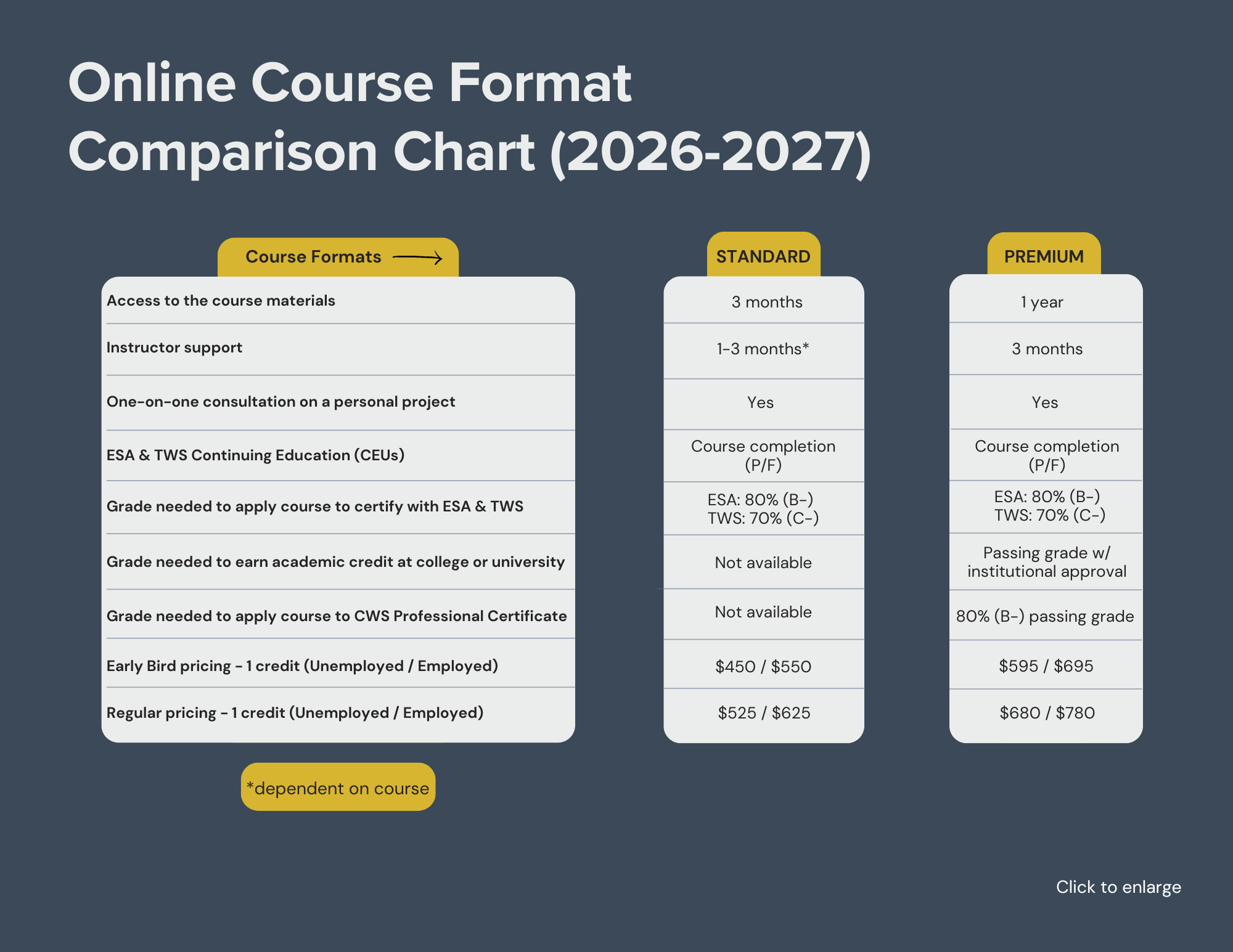
COURSE OPTIONS & INFORMATION (Review chart above, then click below)
-
FORMAT:
15 weeks of access to course materials as you work at your own pace
Get instructor support for the first 5 weeks of each unit via email, discussion threads, group meetings, and one-on-one appointments
After working through the course materials, set up an optional meeting with the instructor to discuss your own personal project from work or school
CONTINUING EDUCATION:
16 CEUs with The Wildlife Society
CERTIFICATIONS:
Earn 1 credit toward certification as an Associate/Certified Wildlife Biologist® (at any level) with The Wildlife Society
-
FORMAT:
12 months of access to course materials as you work at your own pace
Get instructor support for the first 5 weeks of each unit via email, discussion threads, group meetings, and one-on-one appointments
After working through the course materials, set up an optional meeting with the instructor to discuss your own personal project from work or school
CONTINUING EDUCATION:
16 CEUs with The Wildlife Society
Go to our Continuing Education Page for more details
CERTIFICATIONS:
Earn 1 credit toward certification as an Associate/Certified Wildlife Biologist® (at any level) with The Wildlife Society
ACADEMIC CREDIT:
Earn 1 academic credit per unit (go to our Academic Credit page for details)
Earn an additional 1-2 academic credits with an Applied Project

INSTRUCTOR
SCHOLARSHIPS
Full scholarships are available to participants from countries designated as “lower income” and “lower middle income” in the World Bank List of Economies. Please see our CWS World Scholars Program page for details.
CANCELLATION POLICY
Cancellations 30 days or more before the start date are not subject to cancellation fees. Cancellations <30 days before the start date are subject to a 50% cancellation fee. No refunds once the course begins.