 Image 1 of 1
***Watch our free webinar discussion of conservation planning careers here on YouTube***
-
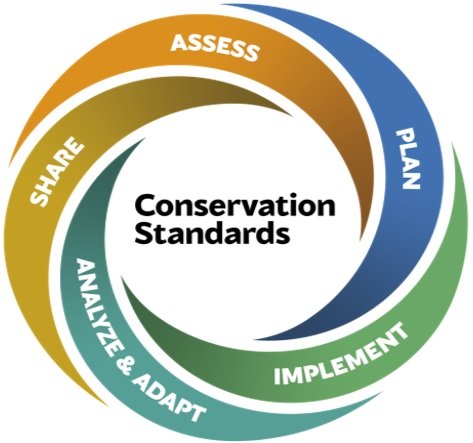
This course combines guided instruction, collaborative learning, and real-world application to help participants design more strategic, adaptive, and impactful conservation initiatives. Grounded in the Conservation Standards—a widely used framework for conservation planning, implementation, monitoring, and adaptive management—the course focuses not only on developing strong plans based on systems thinking, but on helping teams work effectively together in the face of complexity, uncertainty, and competing priorities.
Participants engage individually with a series of short pre-recorded training videos introducing the core concepts and tools of the Conservation Standards, including values identification, situation analysis, threat assessment, theory of change, monitoring, and overall adaptive learning. Live course sessions then focus on applying these tools through facilitated teamwork, discussion, and problem-solving exercises centered around a real-world conservation case study.
Throughout the week, participants work in coach-supported teams to explore how conservation practitioners move from broad visions and ambitious goals toward focused, measurable, and achievable conservation action. The course emphasizes systems thinking, collaboration across disciplines and stakeholders, integrating human well-being considerations, and navigating emerging challenges such as climate change and uncertainty. Rather than treating planning as a simple set of steps, participants apply and experience the Conservation Standards as a practical decision-support framework that helps conservation teams learn, adapt, and improve outcomes over time.
By the end of the course, participants will have developed key elements of a strategic conservation plan while gaining hands-on experience using tools and approaches that can be applied directly within their own organizations, partnerships, and landscapes.
-
Summer:
Live sessions daily: August 10 – 14, 2026
Access to course materials on Canvas: August 3 - November 9
This is a virtual course with live synchronous meetings.
Live sessions meet daily via Zoom from August 10 - 14, 2026. Each session is 4 hours, including breaks. Specific times are TBD based on participants’ preferences.
Sessions will be recorded for those unable to attend, but please note that missing sessions may hinder your learning in the course.
To use class time efficiently, participants will have advance access to training videos for each day’s topics (1-3 videos each day, 10-15 minutes each). During the first 3 hours of each day’s session, the instructor will summarize highlights from the training videos, answer questions, use examples to demonstrate how to apply new principles and tools, and lead the class or breakout group in hands-on activities as if they were a project team developing a strategic plan. In the 4th hour each day, instructors will cover special topics of interest, and/or support participant application of Conservation Standards to their own conservation projects.
Participants will have access to materials on our learning management platform (Canvas) August 3 - November 9.
Early bird discount (saves $75) on registration ends July 19.
-
Early bird* tuition (registrations by July 19th):
$550 students or those who are unemployed
$650 for those who are currently employed
Regular tuition (registrations after July 12th):
$625, students/unemployed
$725, currently employed
*Includes early registration discount of $75. Discount ends July 12.
-
Basic understanding of ecological and conservation practices is helpful, but no prior experience with the Conservation Standards is necessary.
-
Participants should sign up for a free Mural account.
Participants may wish to sign up for a free trial of a Miradi Share account. Note that CWS offers a Miradi course, too.
-
By the end of this course, participants will be able to:
● Explain the purpose, structure, and adaptive management principles of the Conservation Standards framework.
● Work collaboratively with a team to develop key components of an early-stage strategic conservation plan using a real-world case study.
● Define the scope, vision, and conservation context of a project or landscape.
● Identify and analyze ecological and human dimensions of a conservation situation, including direct and indirect threats, stakeholders, and contributing factors.
● Develop and interpret situation models/conceptual models that illustrate the relationships among conservation targets, threats, and drivers within a system.
● Prioritize threats and opportunities to help focus conservation action where it can have the greatest impact.
● Develop results chains and theories of change that link conservation strategies to desired outcomes.
● Draft measurable objectives and identify indicators that support monitoring, learning, and adaptive management.
● Recognize the importance of integrating human well-being, climate considerations, uncertainty, and stakeholder perspectives into conservation planning.
● Reflect on how the Conservation Standards can strengthen collaboration, decision-making, accountability, and learning within conservation organizations and partnerships.